

It’s super frustrating when your iPhone microphone is not working as you cannot make phone calls, use Siri or send voice memos.
Also, you might be in an important class or meeting recording the lecturer’s presentation. With a faulty microphone, you’ll end up with low-quality audio.
You probably would have a clue about the issue. However, your immediate reaction might be to take your iPhone to the nearest Apple Store for repair.
Before you do that, check the troubleshooting tips below. They could possibly solve your iPhone microphone not working problem.
Check Your Microphones
The newer iPhone models come equipped with three microphones. One is located at the top, another at the bottom, and a third is at the rear around the camera. You should try to test each microphone to determine which one is malfunctioning.
Start with the microphone at the bottom and record an audio file using the voice memo application.
Since the other two are implemented for the front and rear cameras, you can record two short videos using the selfie and rear camera.
After that, you should check the audio quality of the recorded file and the videos. As you review each file separately, you know which microphone is faulty. Then, you should consider the following solutions to fix the microphone.
1. Try Restarting Your iPhone
It is not surprising that we advise you to restart your phone first. Some software bugs might lead to microphone problems, and some of these bugs could be fixed simply by attempting a restart.
2. Update Your iPhone to Latest iOS Version
Updating your operating system is always worth a try. With every new update, the developers actively try eliminating bugs and glitches.
Your microphone problem might be one of those glitches that have been addressed in the latest update. To update your iOS:
1. Go to Settings.
2. Tap on General.

3. Then select Software Update.
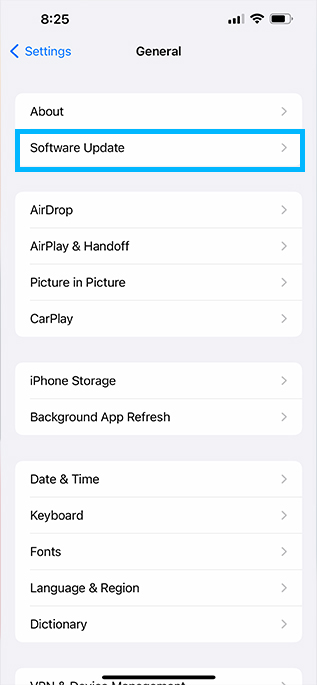
You can download the latest version of iOS on your phone there. If your iPhone microphone is still not working, proceed to the next solution.
3. Clear the Microphones
Check if your iPhone’s screen protector or case is blocking the microphones. Usually, suitable models are designed to accommodate microphone openings perfectly.
However, incompatible third-party cases or incorrectly installed screen protectors could cause microphone problems. So, removing the case and the screen protector is worth a shot.
4. Clean the Microphones
Over time, dust and debris might accumulate in your iPhone’s microphone openings, which could considerably affect the audio quality.
That could be why your voice sounds muffled to other people on phone calls or recorded videos.
You can use any brush (like a toothbrush) to clean the microphone hole. However, avoid using compressed air as much as possible, as it could damage your phone’s internal components.
It goes without saying that inserting sharp objects into the microphone hole could further damage your iPhone, so strictly avoid doing that.
5. Disconnect All Accessories
It might be that your wireless headphones or earbuds have automatically connected to your phone, so your iPhone’s microphone wouldn’t function.
So, make sure that all the devices are disconnected. Remember that all other wireless devices (such as your car’s Bluetooth system and an external Bluetooth speaker) that might connect to your phone could be the source of the problem.
Follow these steps to disconnect all accessories from your iPhone:
1. Head over to the Settings.
2. Then, select Bluetooth.

3. Now turn it off.

You could also do that through the control center.
6. Turn Off Noise Cancellation
Your iPhone’s operating system automatically turns on Noise Cancellation to decrease ambient noise when you make a phone call.
It might be that this feature is not functioning properly and is muffling your voice instead of the intended ambient noise.
To ensure this feature does not reduce your audio input, turn it off from Settings. To do that:
1. First, open Settings.
2. Next, scroll down to Accessibility.

3. Select Audio/Visual.

4. After that, Phone Noise Cancellation.
5. Turn it off.
Note that, according to Apple support, if you have an iPhone 13 model, you will not see this feature because it is not available on these devices.
7. Ensure Microphone Access for the Intended Application
It is often overlooked that applications need to have permission from the user to access the microphone on the device.
If specific applications have problems with the microphone, check your settings to see if they are granted access to the microphone.
1. Go to Settings.
2. Then find and tap on Privacy.

3. Touch Microphone.

You can see which applications have access to the microphone and which don’t. If the problem persists while making phone calls, try turning off all applications’ microphone access.

Then, have somebody call your phone and check if they still have any problems hearing your voice.
8. Restart the App with the Microphone Issues
It is possible that a communication app like WhatsApp or Telegram might have problems with your device’s microphone. Try reopening that application.
However, if your iPhone microphone not working, proceed to the next step.
9. Factory Reset Your iPhone
The last step in every troubleshooting process is to reset your phone to the default settings. There is a chance it could resolve your problem.
1. First, go to Settings.
2. Then tap on General.
3. Scroll down to Transfer or Reset iPhone and touch it.
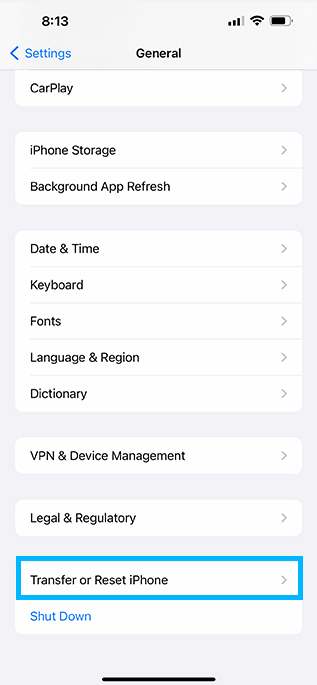
4. After that, select Reset.

5. Select Reset All Settings from the pop-up menu.
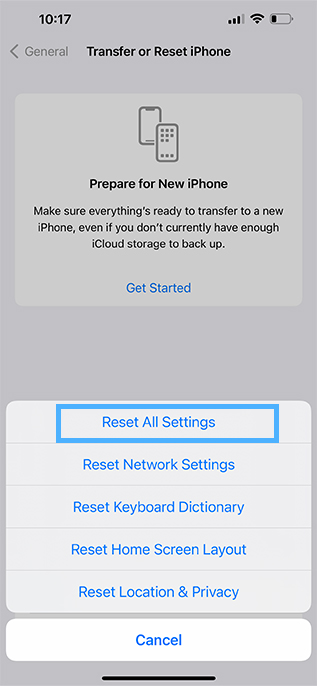
Even though such a reset wouldn’t erase your data, you should certainly back up your iPhone before resetting all settings.
Last but not least, if the solutions mentioned so far don’t fix your microphone problem, feel free to contact Apple support or take your phone to the nearest Apple center.

