
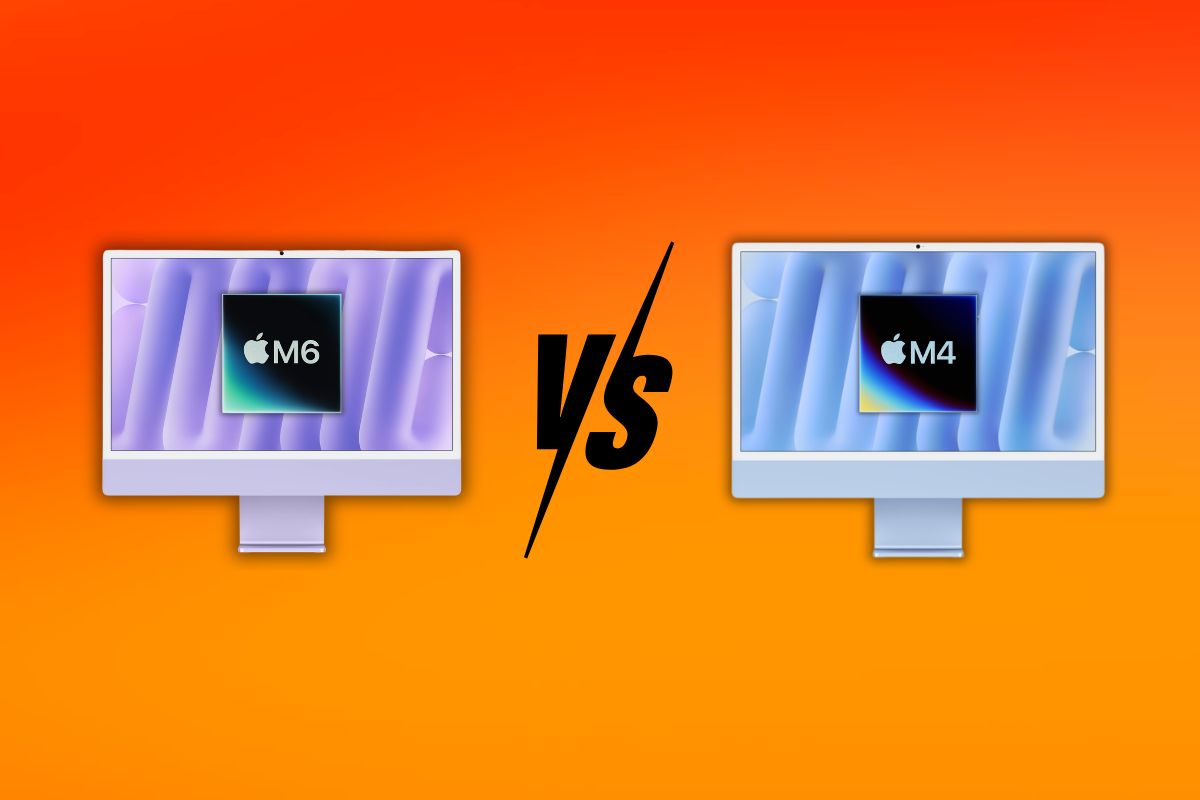
Skipping the M5 generation, Apple’s 24-inch iMac jumps straight from the M4 to the M6, bringing faster performance, faster storage, and upgraded wireless connectivity.
The new model starts at $1,499, matching the M4’s current starting price following Apple’s earlier price increase. Pre-orders opened October 28, with availability beginning November 6.
Despite the two-generation jump, the exterior remains unchanged, including the 24-inch Retina display, camera, speakers, and seven color options.
M6 vs. M4 iMac: Key differences
| Feature | M6 iMac (2026) | M4 iMac (2024) |
|---|---|---|
| Chip process | 2nm | 3nm |
| CPU | 10-core or 12-core | 8-core or 10-core |
| GPU | 10-core or 12-core | 8-core or 10-core |
| Neural Engine | 32-core | 16-core |
| Memory bandwidth | 170GB/s | 120GB/s |
| SSD interface | PCIe 5.0 | PCIe 4.0 |
| Wi-Fi | Wi-Fi 7 | Wi-Fi 6E |
| Bluetooth | 6.0 | 5.3 |
| Ethernet | Up to 2.5Gb | Gigabit |
| Display | 24-inch 4.5K Retina | Same |
How much faster is the M6?
Built on TSMC’s 2nm process, the M6 introduces new super cores alongside its performance and efficiency cores.
Apple claims up to 50% faster Excel performance, twice the graphics performance in certain photo editing and ray-traced gaming workloads, and five times faster AI prompt processing in apps such as LM Studio.
The chip also doubles the Neural Engine to 32 cores, while memory bandwidth increases from 120GB/s to 170GB/s.
Storage benefits from PCIe 5.0, with Apple claiming up to twice the SSD read and write speeds of the M4 iMac.
Networking improves through Wi-Fi 7, Bluetooth 6, and optional or included 2.5 Gigabit Ethernet, depending on configuration.
Should you upgrade from an M4 iMac?
For most M4 owners, probably not.
The M4 remains more than capable of handling everyday browsing, office work, streaming, and video calls. Since the display, camera, speakers, and design haven’t changed, upgrading won’t noticeably improve those experiences.
The M6 makes a stronger case for users who regularly do demanding photo editing, graphics, gaming, or local AI applications.
Even then, replacing a two-year-old computer solely for faster performance may be difficult to justify.
Wi-Fi 7 and faster Ethernet are welcome improvements, but you’ll need compatible networking equipment to benefit fully.
Which iMac should new buyers choose?
At similar prices, the M6 is the better purchase. It offers more performance headroom, faster storage, and newer connectivity without costing more than the current retail price of the outgoing M4.
A discounted M4 iMac remains worth considering, particularly for basic home or office use where the performance difference is unlikely to matter.
The M6 iMac starts at $1,499 for the two-port model and $1,699 for the four-port configuration, with shipments beginning November 6.

