
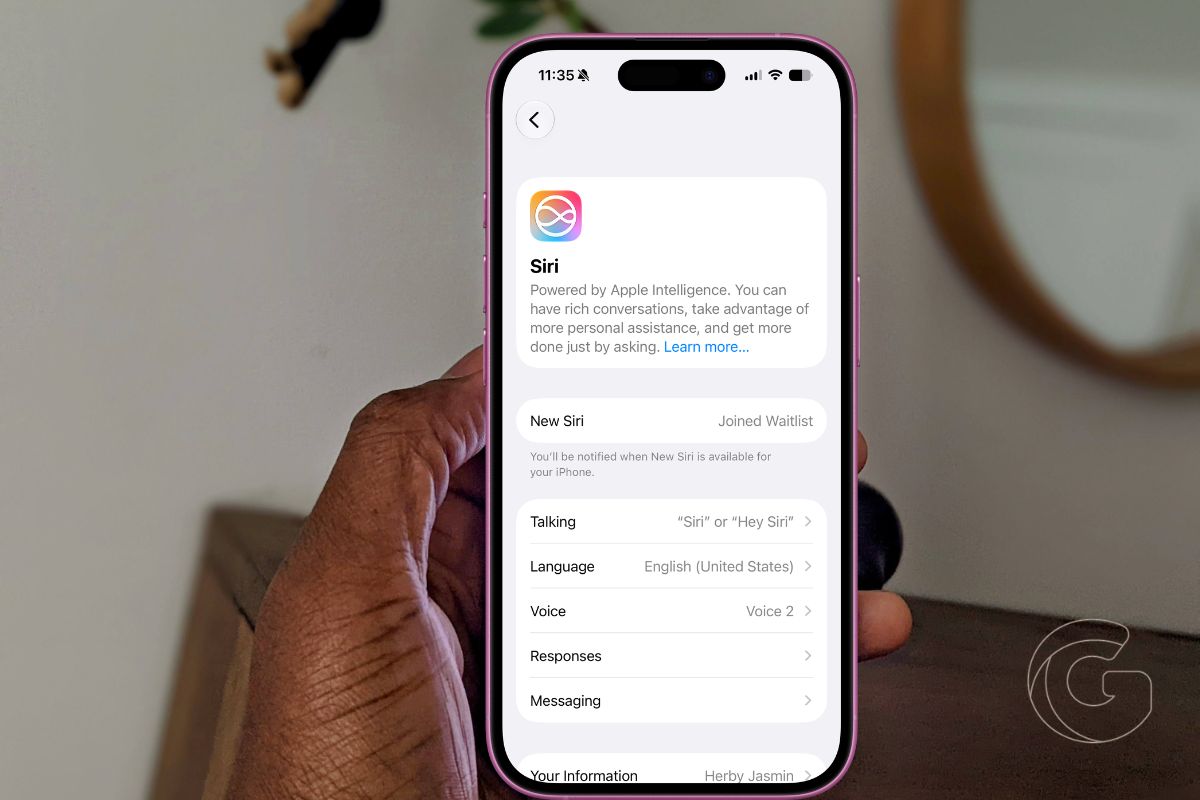
Millions of iPhone users in the European Union will open iOS 27 this fall and find a blank space where Siri AI should be. Apple says regulators forced its hand, but the EU says that story does not hold up.
Apple’s software chief Craig Federighi described the situation as a failure of cooperation. Regulators, he said, refused to engage meaningfully with Apple’s proposed solutions, including a system called the Trusted System Agent, designed to let third-party AI assistants securely access device features.
Apple framed the Digital Markets Act as demanding something close to unrestricted access to a user’s device, which it called unacceptable.
The European Commission pushed back hard. A spokesperson told reporters in Brussels that Apple never actually tried to find a workable solution.
Instead, Apple asked to be entirely exempt from its legal obligations, a request that was refused. According to regulators, you cannot simply opt out of the law because compliance is inconvenient.
This is not a minor omission. Siri AI is the centerpiece of iOS 27. It powers a dedicated conversation app, deeper system-level controls, and the kind of contextual assistance that makes the new software worth upgrading to.
EU users pay the same price for their iPhones as everyone else. They will receive a version of iOS 27 with its most significant feature simply absent, and no firm date has been given for when that might change.
Apple says it hopes to eventually bring Siri AI to Europe. That word, eventually, is doing a lot of work in that sentence.
Apple launched Siri AI in China. China, which operates under far more restrictive technology rules than any EU regulation, still gets the feature.
If the core problem were regulatory overreach, China would seem like the harder market to satisfy, not the easier one. That asymmetry is difficult to explain away with a purely technical argument.
What the EU situation looks like, based on the Commission’s account, is a company that wanted a legal carve-out rather than a compliance solution.
The Commission made clear that carve-outs are not on offer under the Digital Markets Act. Apple responded by pulling the feature entirely and pointing at Brussels.
For the average EU iPhone owner, the political dispute is background noise. What matters is that a flagship feature they cannot access is sitting on devices they already paid for, with no timeline attached and two sides publicly contradicting each other about whose fault that is.


EU customers have many phones they can choose to buy, no one is stopping them. If their version of the iPhone is missing SIRI and it’s important that a phone have all the things SIRI offers then buy a Google phone or variations of it. Who is stopping them. EU wants to take away the “walled garden” Apple has, problem is that’s why people like myself buy Apple, for the “Walled Garden!” That’s the real product and the EU wants to keep watering it down until it’s just like everyone else. If I want everyone else I will buy something different. I don’t need government to tell me that.