
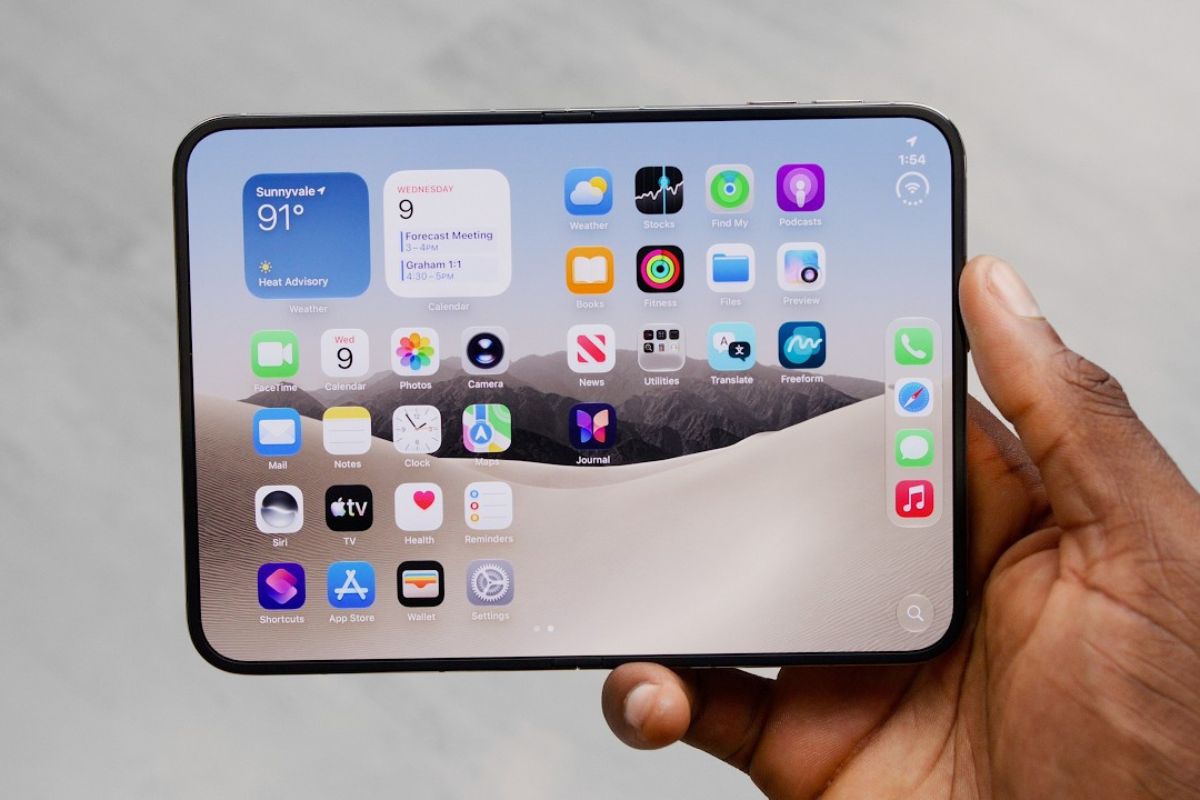
Apple hardware engineering VP Tom Marieb is asking buyers of the upcoming iPhone Duo to judge the company on one of the most persistent problems with foldable phones: how the crease holds up over time.
In a new interview, Marieb said Apple chose a matte nano-texture finish for the Duo’s inner display partly because it makes the fold line less visible, particularly as the hinge and screen age.
“Hold us accountable to that, please,” Marieb said.
Glossy displays tend to make subtle surface changes easier to see because of how they reflect light. The Duo’s matte finish is meant to soften those reflections, reducing glare while making variations around the fold less noticeable.
“When you look at glossy displays, their specularity makes it very easy to pick up topology differences,” Marieb said. “That’s part of the reason we picked the matte finish.”
Apple isn’t claiming the Duo has somehow eliminated the physical realities of a folding screen. Instead, the company has designed the display surface to make the crease harder to see in everyday use and less obvious as the device ages.
Years of work went into the hinge
The display is only part of Apple’s attempt to address that problem.
Marieb said the Duo’s hinge took years to develop, with engineers paying close attention to the resistance users feel as they open and close the phone.
“We really worked on the torque profile very heavily,” he said, comparing the intended feel to shutting the door of a high-end car.
The goal was to make the mechanism feel solid and controlled rather than loose, giving users confidence that repeatedly folding the device isn’t hurting it.
That becomes more complicated because the hinge isn’t designed for only two positions. The Duo can remain partially folded at different angles for watching video, making FaceTime calls, and other uses while sitting on a table or being held.
Maintaining the right resistance throughout that range required changes to the hinge’s mechanical properties. Marieb said “a lot of blood, sweat, and tears” went into getting that behavior right.
Apple’s hardware chief doesn’t want a screen protector either
Marieb also reacted much more strongly when the conversation turned to protecting the outer display.
The Duo uses Ceramic Shield 2 on the outside, and Marieb said seeing a screen protector on an iPhone makes his “skin crawl.”
Apple has spent years improving the scratch and drop resistance of its display glass, and Ceramic Shield 2 is the company’s latest attempt to make additional protection less necessary.
Of course, buyers spending $1,999 on a first-generation foldable may still feel differently about taking that chance.
The iPhone Duo opens for pre-order on October 16 and goes on sale on October 23 starting at $1,999.

