
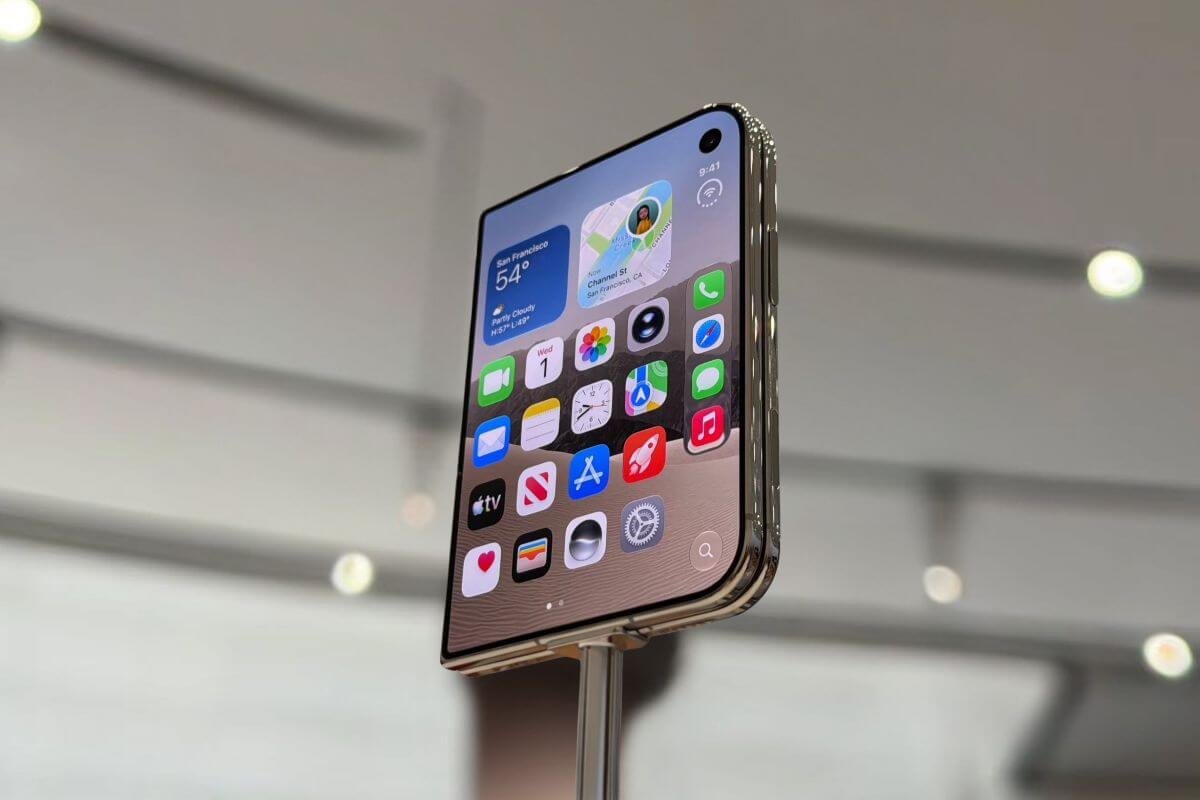
Apple’s first foldable iPhone starts at $1,999, a full $800 more than the iPhone 18 Pro and $700 more than the Pro Max.
Yet despite its higher price, the iPhone Duo comes with a less capable camera system and several compromises you won’t find on Apple’s traditional flagship models.
All three phones share the A20 Pro chip, 120Hz ProMotion OLED displays, and the latest Apple Intelligence features in iOS 27.
The biggest difference is what you’re paying for. With the Pro models, the money goes toward Apple’s most advanced iPhone cameras. With the Duo, you’re paying for a folding design that turns your phone into a small tablet.
That larger screen has its advantages, but the compromises become harder to ignore when you compare the hardware.
The iPhone 18 Pro Has a Much Better Camera System
The iPhone 18 Pro features a variable aperture main camera that adjusts between f/1.48 and f/4.0, giving photographers more control over light and depth of field.
It also has a dedicated 48MP Telephoto camera with 4x optical zoom, 8x optical-quality zoom, and a LiDAR scanner.
None of those features are available on the Duo. Its main camera uses a fixed f/1.6 aperture, while zoom is limited to a 2x sensor crop rather than a dedicated telephoto lens.
The differences extend to video and professional photography. The Pro models support ProRAW, ProRes, Apple Log 2, and more manual controls, while the Duo offers fewer shooting formats and settings.
Even the front cameras differ. The Pro has an 18MP autofocus camera, while the Duo has a 12MP outer camera. The foldable’s inner camera is primarily intended for video calls and lacks Night mode, Portrait mode, and Photographic Styles.
Beyond photography, the Duo replaces Face ID with Touch ID built into the side button and drops the customizable Action button found on the Pro models.
What the iPhone Duo Does Better
Open the Duo, and its 7.6-inch display offers something neither Pro model can match: two apps running side by side in Split View.
That extra space helps when reading documents, switching between apps, or watching videos. The folding design also lets you prop up the phone for hands-free FaceTime calls or photography without carrying a separate stand.
Apple Pencil support is expected later in 2026, potentially adding another reason to choose the Duo for note-taking and document annotation.
Battery life, however, isn’t necessarily better despite the larger device. Apple’s estimates put the Duo roughly on par with the smaller iPhone 18 Pro in typical use, while the Pro Max lasts longer.
The Duo can deliver up to 44 hours of video playback on its outer screen, dropping to 31 hours with the larger inner display.
The Price Difference Goes Beyond $800
Buying the Duo is expensive enough, but repairing one could be even more painful.
An out-of-warranty inner display replacement costs $999, compared with $329 for the iPhone 18 Pro and $379 for the Pro Max. Battery replacement costs $229 on the Duo versus $129 on either Pro model.
AppleCare+ with Theft and Loss is also more expensive at $19.99 per month, compared with $14.99 for the Pro models.
Storage makes the comparison particularly interesting. A 1TB iPhone 18 Pro Max costs $1,899, which is still $100 less than the entry-level Duo with just 256GB.
The Duo is also wider and thicker when folded than either Pro model, weighing 8.96 ounces, slightly more than the Pro Max.
Which iPhone Should You Buy?
For most buyers, the iPhone 18 Pro or Pro Max makes more financial sense. Both offer stronger camera systems without the added expense of a folding display, and the Pro Max provides better battery endurance.
The Duo is worth considering if you’ll regularly use its larger screen for multitasking or want a phone that can double as a compact tablet.
Those advantages are difficult to replicate on a conventional iPhone, but they come at a substantial premium.
The iPhone 18 Pro models are already available, while the Duo goes on sale October 23 following preorders that opened October 16.
Some shipping estimates have reportedly slipped into 2027, so availability could also influence the decision.

